
Robeson Probation and Parole Status
North Carolina places probation, parole, and post-release supervision in the state Community Supervision system, but the legal paths differ. Probation comes from a court judgment. It can replace a term of active imprisonment or follow a short confinement term. A supervised probationer reports to an officer and follows court conditions. Unsupervised probation has no assigned field officer and may not appear as an active Community Supervision case.
Parole is conditional release before an eligible prison sentence expires. It now applies chiefly to older sentencing law. Post-release supervision, often shortened to PRS, is the community part of a Structured Sentencing prison term. Someone on parole or PRS has left prison, but the sentence has not necessarily ended. The North Carolina supervision definitions describe a supervisee as still in the custody of Community Supervision and the Commission.
| Status | Who orders it | What release means |
|---|---|---|
| Probation | Trial court | The person follows court conditions, sometimes without a prior prison release. |
| Parole | Post-Release Supervision and Parole Commission | Conditional prison release under an eligible sentence. |
| Post-release supervision | Required by Structured Sentencing; conditions set by the Commission | Prison confinement ended, while the maximum sentence continues in the community. |
- Discharge
- The formal end of a supervision case or sentence.
- Absconder
- A supervisee reported out of contact or not complying with supervision.
- Revocation
- A legal action that can return a person to confinement after a violation finding.
- Transfer
- Movement of supervision or custody to another office, county, state, or facility.
Check Robeson Post-Release Supervision
The official starting point is the NCDAC Offender Public Information Search. It contains current and historical state prison, probation, parole, and PRS information. It does not contain every Robeson County jail-only event. Use the seven-digit DAC offender number when available because that identifier remains tied to the person across later DAC episodes. A county booking number is a different identifier.
- Select Active Probationer/Parolee and enter the DAC number, or use the full name with birth and physical details.
- Repeat the search under Inactive when final discharge is claimed. Review every episode instead of relying on one results label.
- Match at least two identifiers. Note the supervision type, office, status, sentence history, and any actual prison release date.
- Use the current office directory when confirmation is needed. Supervision may occur outside the county of conviction or move through an interstate compact.
- Check the Robeson jail catalog and SAVAN when a later violation booking or new custody event is possible. An active state label may coexist with county custody.
An actual prison release date followed by active PRS or parole is strong evidence of a transition from prison to supervision. An inactive filter result is broader. It can represent a concluded episode, and it must not be treated as a release on the date of the search. Likewise, disappearance from the active filter is not by itself proof of discharge.
The NCDAC Victim Support Services explanation also distinguishes conditional parole, law-set PRS, custody reviews, and actual release. These labels matter. A custody-review date is an internal classification review, not a release date or parole hearing.
Robeson Supervision Office Lookup
After a record identifies active supervision, locate the assigned field office through the NCDAC Community Supervision office directory. Do not assume the office from the conviction county. A supervisee can live elsewhere, move between judicial divisions, or have qualifying supervision transferred to another state.
The official directory capture below shows the live division map and office roster. The record itself, not the screenshot, establishes a named person’s current assignment.
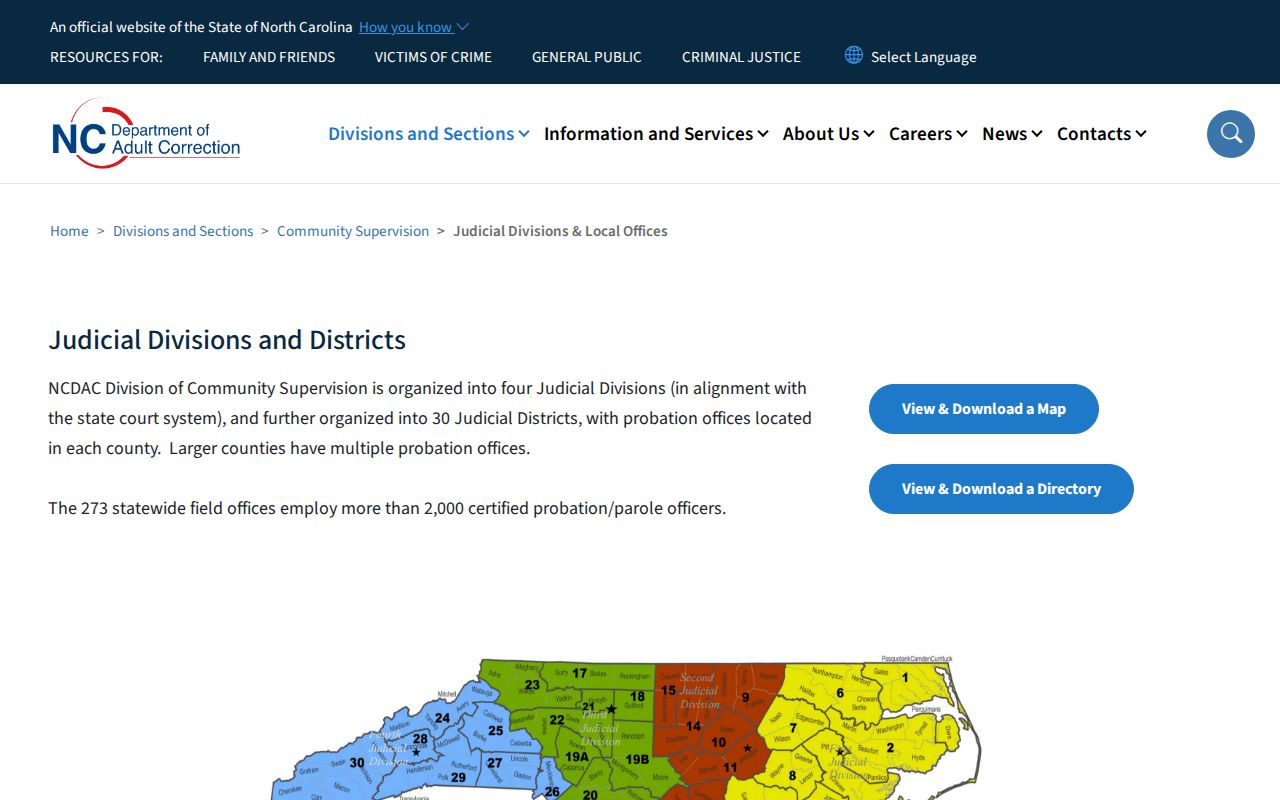
When contacting an office, provide the correct DAC number and ask for public status information. Avoid using a similar name as the match. The supervising office can also explain where a public-record request should go if the online history does not resolve the question.
North Carolina Community Supervision
Agency: North Carolina Department of Adult Correction
Decision body: North Carolina Post-Release Supervision and Parole Commission
Local route: Current judicial-division and field-office directory
Search key: Seven-digit DAC offender number when known
Robeson Supervision Violations and Absconders
NCDAC provides an Absconders search through its offender-search resources. An absconder status means the agency reports lost contact or alleged failure to comply. It is not a clean discharge. It also does not prove current confinement. A later capture, violation hearing, revocation, intermediate sanction, or new booking may follow.
Reconcile the state record with Robeson Police2Citizen, SAVAN/VINELink, and the court case when the status matters. A county booking can reflect a supervision violation while the NCDAC record still shows community supervision. The reverse also occurs: an absconder entry can remain while the person is not found in the county jail. Ask which system last confirmed contact or custody.
Conditions vary by judgment and supervision type. At a high level they may require reporting, approved residence or travel, program participation, and compliance with court or Commission orders. The public search does not replace the controlling judgment or conditions document.
Robeson Parole Decisions and Release
The North Carolina Post-Release Supervision and Parole Commission handles discretionary release in eligible old-law cases and sets conditions for parole and PRS. Commissioners ordinarily review files and vote independently. There is no conventional public calendar of group parole hearings. The public results channel is the monthly discretionary parole review data.
A decision label is not always a gate-release event. “Incomplete” means more information is needed. “Suspend” stops consideration at that time. Regular parole is conditional release, but an approval may still precede an investigation, plan completion, target date, change, or rescission. Pair any favorable decision with an actual release date and active parole status in OPI.
Structured Sentencing largely ended ordinary parole for offenses committed on or after October 1, 1994. Old-law eligibility and narrow later exceptions depend on the offense date and sentence. This is why a general claim that every state prisoner receives a parole hearing is wrong. The record and the law governing that sentence control.
Robeson Reentry Help After Release
Robeson County maintains an Offender Resource Center with a named reentry contact and weekday service hours. It helps people navigate local reentry needs. It is not a custody database and cannot prove that a named person left jail, began parole, or completed probation.
The Robeson County Offender Resource Center is at 120 West Sixth Street in Lumberton and is open Monday through Friday, 8:15 a.m. to 5:15 p.m. The listed reentry contact is Angelina Phillips at 910-608-2118 or 910-827-9073. Pretrial Services at the same resource center reviews qualified defendants for pretrial release or electronic house arrest, but that path is supervised pretrial status, not probation discharge or sentence completion.
Keep the functions separate. Use OPI and the assigned supervision office to verify legal status. Use the resource center for navigation after release. Use the originating court or corrections custodian for the document that proves a final discharge.
Confirm Robeson Supervision Discharge
Supervision ends through a recorded termination or discharge, not merely because an online active search stops returning the person. Under the North Carolina PRS term statute, completion of post-release supervision terminates the sentence or sentences from which the person was released. Probation and parole have their own orders and case histories.
Search both active and inactive OPI records, preserve the exact status and check date, and ask for the public part of the DAC record when the history remains unclear. The full Robeson release path is also covered on the county released-inmate search. A later Robeson booking does not erase an earlier prison release, but it changes any claim about present custody.
Use exact wording in notes: “released to post-release supervision,” “active supervised probation,” “on parole,” or “supervision terminated.” That phrasing preserves the difference between leaving a building and completing every legal obligation.
A final check should reconcile the state record with the court or Commission source that created the status. A probation judgment can show the term and conditions, while OPI shows the public supervision episode. For parole or PRS, an actual prison release date and an active Community Supervision label can coexist. When OPI later shows an inactive record, read the episode dates before calling it discharge. Inactive can describe a completed term, but it is also a broad search filter rather than a same-day certificate. If the dates or labels conflict, request the public basic record from NCDAC and ask the assigned office which order closed or changed the case.
Search Public Records
Sponsored Results