
Robeson Projected Versus Actual Release
A projected date answers what the current sentence calculation predicts. An actual release date records a completed exit. The two fields should never be used as synonyms. North Carolina prison calculations can change when credit, discipline, assignments, court action, or governing law changes. Robeson’s county jail interface likewise distinguishes a future “Expected release” from a past “Released on” entry with a date and time.
Custody context determines the meaning. A person awaiting trial may leave after bond, a court order, dismissal, transfer, or another event with no long-term sentence calculation. A sentenced local-jail inmate may have a date shaped by the judgment, jail credit, and lawful local earned-time rules. A state prisoner’s projection comes from NCDAC’s sentence record.
A transfer date is neither one. Movement from the Robeson County Detention Center to NCDAC, another jail, or another authority ends one facility stay but does not place the person in the community.
Find a Robeson Projected Release
Begin with the agency that holds the person. The NCDAC Offender Public Information Search covers state prison, probation, parole, and post-release supervision. It does not cover a person whose only custody was a Robeson County jail booking.
- Identify the custody system. Use Police2Citizen for the county jail and NCDAC OPI for state prison or Robeson CRV.
- Search by the strongest identifier. A seven-digit DAC number is better than a common name for a state record.
- Open the full sentence history. Label projected release, actual release, admission, status, and custody-review dates separately.
- For a county case, inspect the jail’s expected or completed release field and check the court judgment, bond, and any hold.
- Confirm a completed exit with the actual release history, county release date and reason, or a focused record from the custodian.
The official state offender search shown below is the correct state-prison route. A result should be matched by more than a name, and an inactive filter should not be treated as a same-day release list.
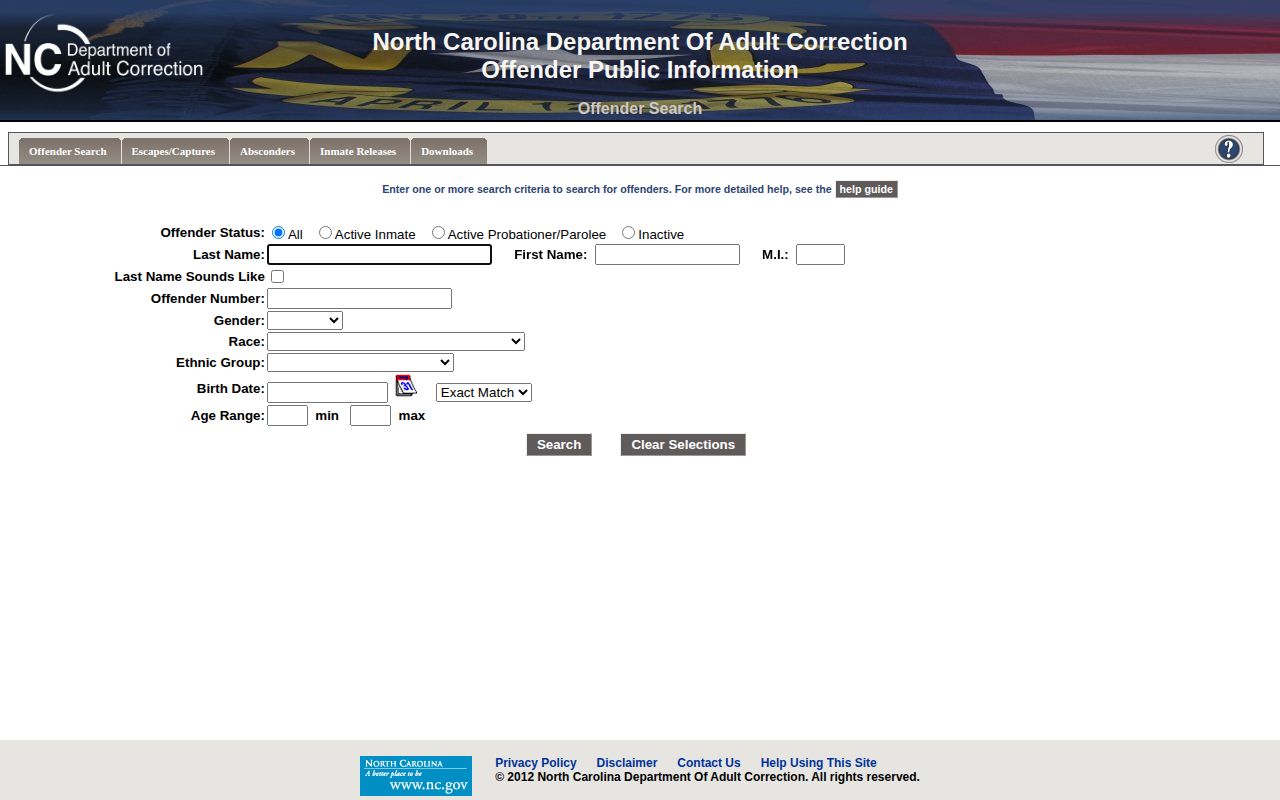
When the custody path is unclear, check both active and inactive state filters plus the Robeson jail catalog. A person may have more than one episode or identifier.
Robeson Release Dates Under Sentencing
North Carolina’s major sentencing divide is the offense date. Fair Sentencing applies to felony crimes committed from July 1, 1981 through September 30, 1994. Structured Sentencing applies to offenses committed on or after October 1, 1994. Old-law cases can involve parole and credit rules that differ sharply from a current Structured Sentencing term.
For a Structured Sentencing felony, the judgment contains minimum and maximum terms. G.S. 15A-1340.13 requires service of the minimum, subject to a specific statutory exception, and lets earned time reduce the maximum but not below that minimum. Court-ordered jail credit counts toward service. The minimum is thus the usual confinement floor.
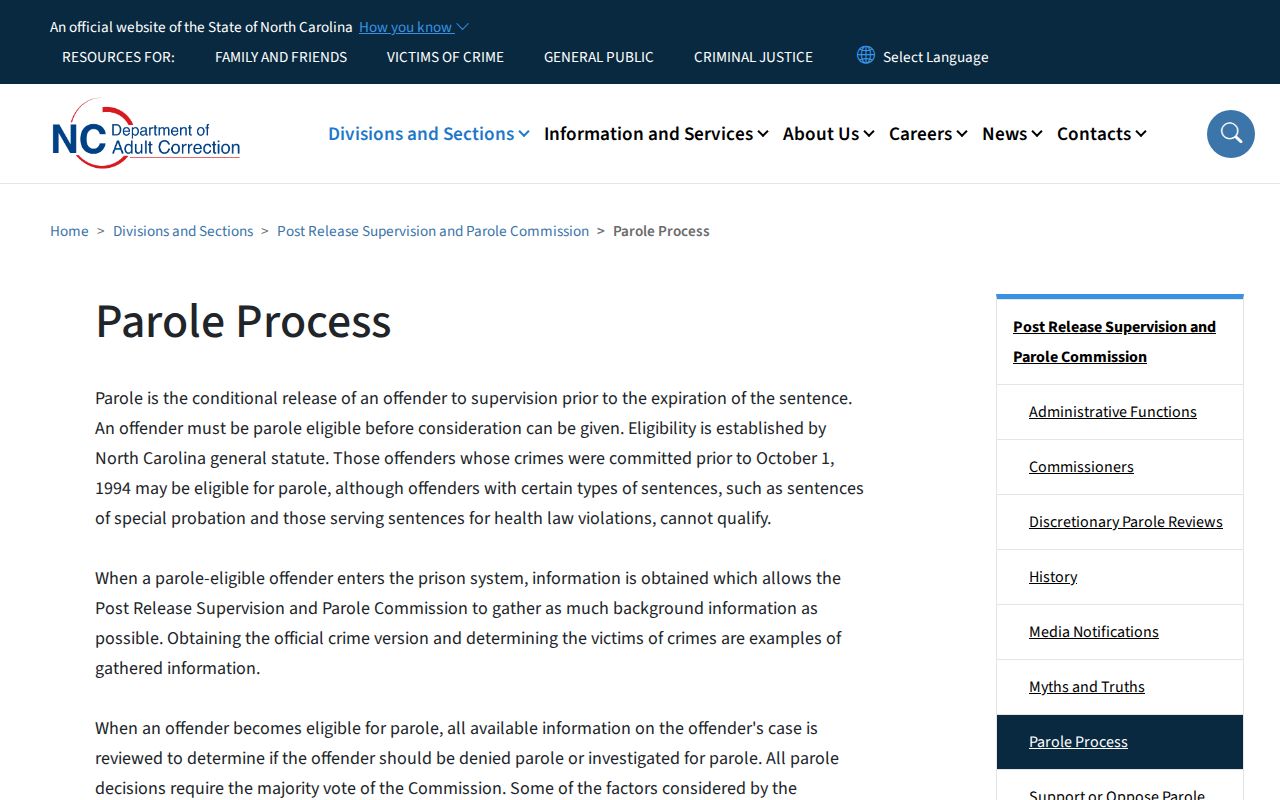
The Commission’s official parole-process explanation summarizes Structured Sentencing as at least 100 percent of the minimum and 85 percent of the maximum. That is not a promise that good conduct removes 15 percent from every sentence. The actual calculation uses the judgment, offense law, jail credit, earned time, sentence structure, and mandatory post-release formula.
The source capture below shows the state’s process explanation. It provides legal context, while the individual NCDAC record supplies the person’s current calculation.
Special maximum-term rules also support periods of post-release supervision. Those extra months should not be reported as automatic extra prison confinement in every case.
Robeson Earned Time and Release
NCDAC says a Structured Sentencing prisoner earns time through a work assignment or full-time program. Earned credit may move the projected confinement date from the maximum toward the minimum. It cannot move the date below the lawful minimum under the standard rule.
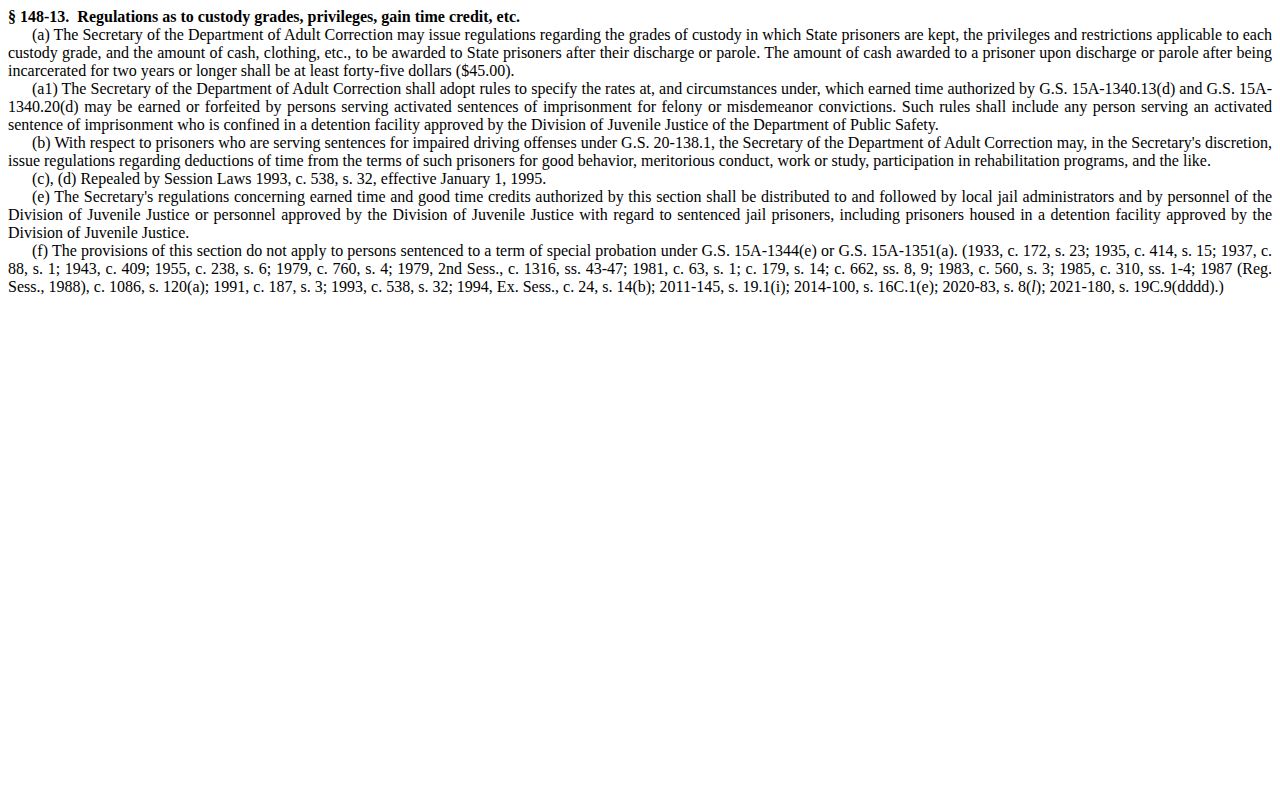
G.S. 148-13 directs DAC to adopt rules governing when earned time can be earned or forfeited. The statute also extends governing regulations to local jail administrators for sentenced jail prisoners. For an activated misdemeanor sentence, G.S. 15A-1340.20(d) caps combined earned-time awards at four days per month.
Fair Sentencing credit works differently. NCDAC describes good time at one day for each day of good behavior for qualifying old-law offenders, subject to loss after discipline. Gain time can vary with work or program assignment. Merit time can apply in defined work or emergency circumstances. The offense date and sentencing scheme must be known before any credit claim is made.
The official earned-time statute capture below shows the authority. It does not calculate a named person’s date; only the current corrections record can do that.
Note: Good time, gain time, and earned time are not interchangeable labels, and none proves that release processing has occurred.
Why Robeson Release Dates Change
A future date is recalculated when the source facts change. Some changes move the projection earlier. Others move it later or replace it with a different custody path. Always record the date of the lookup.
| Change | Possible effect |
|---|---|
| Earned credit accrues | May move confinement from the maximum toward the minimum. |
| Discipline or forfeiture | Can remove credit and move the forecast later. |
| Work assignment or program ends | Can alter the rate or availability of earned credit. |
| Court awards jail credit | Changes time already counted toward the sentence. |
| Resentencing or vacated judgment | Can replace the controlling terms. |
| Consecutive or overlapping terms | Can change which sentence controls the calculation. |
| Detainer or new custody order | May prevent community release even when one term ends. |
NCDAC also identifies transfers, completion of assignments, changes in legislation or case law, confinement-limit decisions, and old-law parole as causes of movement. A routine next custody-review date concerns security classification, generally on a periodic schedule. It is not a parole review or release date.
- Projected release
- The current forecast under the correctional calculation.
- Actual release
- A recorded completed custody exit.
- Detainer
- A request or order that another authority hold or receive the person.
- Post-release supervision
- The community portion of a Structured Sentencing prison term.
Robeson Jail Release Date Limits
State felony formulas should not be imposed on a Robeson bond case, dismissed charge, civil hold, transfer, or unsentenced detention. The county interface can display an expected release date, but court action and jail processing control what happens next. A bond amount does not show that bond was posted. A court order can precede physical exit.
For a local sentenced term, compare the judgment, jail credit, expected field, and final Police2Citizen release date, time, and reason. If the record disappears, request the existing booking-and-release record from the sheriff. Ask for the release code, releasing authority, and transfer destination as well as the timestamp.
A disappearance can also reflect spelling, a publication exclusion, delay, sealing, expunction, or transfer. Robeson’s documented use of overflow and safekeeper placements makes the receiver question especially important. Ask whether the booking ended in community release or movement to NCDAC, another jail, or another authority.
No official Robeson source publishes a general calculation tool or promises that an expected date will hold. The county also has no verified fixed recent-release window. Use a named search and confirm the event rather than estimating from an arrest date. A records request should seek the existing identified record, not demand creation of a new release compilation.
Confirm Robeson County Actual Release
For state prison, an actual release date in sentence history plus an active parole or PRS episode is stronger than a projection alone. For county jail, a completed release date, time, and reason tied to the booking is the direct portal evidence. Neither one guarantees that no other authority took custody.
Use the Robeson VINELink inmate search for custody-change alerts, then return to the source system. An “out of custody” notice is corroboration, not a certified sheet. If release is followed by supervision, describe the status precisely.
When records conflict, ask who held the person next and when. A transfer from Lumberton Correctional Institution to another prison is not release. Leaving Robeson CRV generally returns a participant to community supervision, not unconditional discharge. The record must show whether the sentence or supervision later terminated.
Monthly parole decision spreadsheets also require care. An incomplete decision calls for more information, and a suspended decision halts review. Even a favorable parole outcome can precede release-plan work or later change. Return to OPI for the actual release event and active parole status rather than converting a review result into a gate date.
Preserve the system name, filters, identifiers, exact result language, and lookup time. Include the offense-date sentencing scheme and the court terms when a forecast is explained. This makes clear whether the evidence is a prediction, a reported event, a conditional prison exit, or final discharge.
Search Robeson Release Date Records
The DAC offender number is the strongest state key because NCDAC keeps it across release and later return. Do not enter a Robeson booking number as though it were a DAC identifier. With a name search, use the available birth, age, race, gender, and physical-description filters to separate similar records, then read the full sentence history. For a person thought to have finished custody and supervision, start with Inactive. If prison confinement may have ended but parole or PRS continues, repeat under Active Probationer/Parolee. Searching All helps when several episodes or an uncertain status make either narrow filter incomplete.
A state search should also be paired with the correct local evidence. Police2Citizen records a Robeson jail’s expected or completed release fields, while eCourts can show the order, judgment, or bond action behind the custody path. Neither portal replaces the other. The court event may occur before staff complete release processing, and an expected county date can change after a new order or hold. Keep the field label and source with every date.
Search Public Records
Sponsored Results